
THE PROCESS IS PART OF THE PRODUCT:
Manufacturing Quality, Biological Variability, and the Next Era of Regenerative Medicine
September 10, 2026 • auragens.com

📥 Download the Full Newsletter
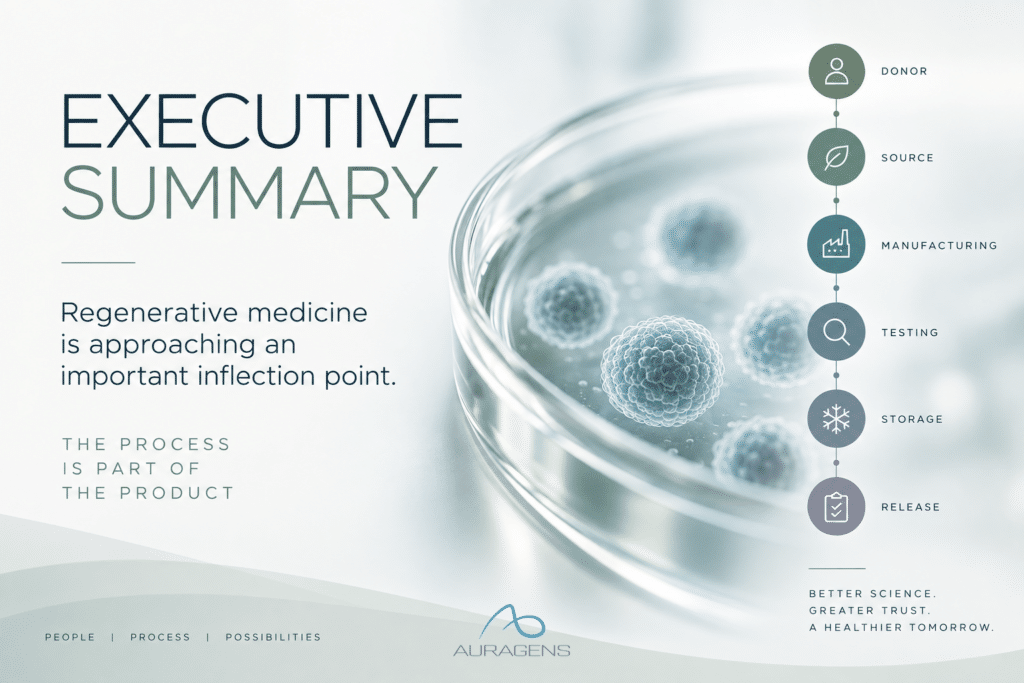
Executive Summary
Regenerative medicine is approaching an important inflection point.
For much of the past decade, public discussion surrounding cellular therapies has focused on a relatively simple question:
Do stem cells work?
That question is increasingly inadequate.
A more mature field must ask something considerably more demanding:
What cells? From what source? From which donor? Manufactured under what conditions? Expanded according to what process? Characterized against what specifications? Tested how? Stored how? Released according to what criteria? And supported by what quality system?
These distinctions matter because a cellular therapy is not defined solely by the name of the cell being administered or by the number of cells contained in a vial.
Cells are living biologic products. Their characteristics may be affected by donor variability, tissue source, culture environment, expansion, passage, processing, storage, handling, and other manufacturing variables.
The scientific and regulatory communities increasingly recognize this complexity.
Researchers affiliated with Stanford University have documented significant donor-to-donor variability in human mesenchymal stromal/stem cell differentiation.[1]
Researchers at Mayo Clinic have emphasized the importance of standardized manufacturing and recently reported experience encompassing 15 years, 17 clinical trials, and 389 patients using a core standardized MSC manufacturing platform.[2]
In 2025, Mayo Clinic researchers also noted a central challenge facing the field: while MSCs have consistently demonstrated encouraging safety across clinical trials, demonstration of efficacy has remained inconsistent.[3]
And in 2026, the U.S. Food and Drug Administration (FDA) placed renewed attention on Chemistry, Manufacturing, and Controls—CMC—in the development of human cellular and gene therapy products.[4]
Meanwhile, AABB continues to maintain and evolve standards governing donor eligibility, collection, processing, storage, administration, and other components of cellular therapy practice.[5]
Taken together, these developments point toward a fundamental principle:
The process is part of the product.
For Auragens, this principle sits at the center of Project Redwood: our ongoing effort to examine where regenerative medicine is today, where its vulnerabilities remain, and what will be required for the field to earn lasting trust.
The future of regenerative medicine should not be determined by who advertises the largest number of cells.
It should be determined by our collective ability to understand, characterize, manufacture, test, document, and responsibly deliver biologics worthy of being called medicine.

1. Regenerative Medicine Is Entering Its Quality Era
Emerging areas of medicine often progress through recognizable stages.
First comes discovery.
Then possibility.
Then enthusiasm.
Then proliferation.
Eventually, however, a serious medical discipline must confront a more difficult stage:
standardization.
Regenerative medicine appears to be entering that period now.
This transition can be seen clearly in the FDA’s evolving approach to cellular and gene therapy development.
In May 2026, FDA’s Center for Biologics Evaluation and Research issued final guidance titled Chemistry, Manufacturing, and Controls Flexibilities for Developing Human Cellular and Gene Therapy Products for a Biologics License Application.[4]
The guidance is important for what it acknowledges.
Cellular and gene therapies possess unique characteristics that can make conventional pharmaceutical development paradigms difficult to apply without flexibility. FDA therefore describes a flexible approach to CMC requirements intended to facilitate development and patient access while continuing to ensure that applicable requirements for biological products are satisfied.[4]
Flexibility, however, should not be confused with the absence of standards.
It means developing regulatory approaches appropriate to the biological complexity of these products.
Then, in August 2026, FDA issued additional final guidance addressing frequently encountered questions in the development of potential cellular and gene therapy products. The document addresses regulatory review, CMC, pharmacology/toxicology, clinical development, and clinical pharmacology, with the stated objective of facilitating development of safe, effective, and high-quality cellular and gene therapy products.[6]
This is an important moment.
The conversation is moving beyond whether cellular therapies are scientifically interesting.
The question increasingly becomes:
How do we manufacture them responsibly and consistently enough to become reliable medicine?

2. A Stem Cell Is Not a Commodity
The phrase “stem cells” creates an understandable misconception.
It sounds like a standardized product category.
A patient may reasonably assume that 100 million MSCs from one provider are fundamentally equivalent to 100 million MSCs from another.
Biologically, that assumption is difficult to defend.
Mesenchymal stromal/stem cells are living biological systems, not interchangeable manufactured widgets.
Even before manufacturing is considered, variability exists.
A recent study involving researchers from the Departments of Chemistry, Bioengineering, Biology, and Orthopedic Surgery at Stanford University and Stanford University School of Medicine examined MSCs from six human donors.[1]
Researchers evaluated differentiation into chondrogenic, osteogenic, and adipogenic lineages using conventional and three-dimensional culture models.
They observed significant donor-to-donor variability across all three lineages and across the culture systems studied.[1]
The implications extend beyond any individual experiment.
The donor matters.
The biological starting material matters.
And if biological variability exists before substantial manufacturing begins, then responsible manufacturing must account for that variability rather than assume it away.
A 2026 review examining limitations in MSC clinical translation reached a similar conclusion, identifying inter- and intra-donor variability in MSC function, differentiation capacity, and proliferation rate alongside the need for standardized characterization and reporting.[7]
The term “MSC,” therefore, describes a category.
It does not, by itself, establish equivalence.

3. Why Manufacturing Matters
Once cellular material has been sourced, manufacturing introduces another series of variables.
Isolation.
Culture conditions.
Expansion.
Media.
Passage.
Confluence.
Harvesting.
Processing.
Cryopreservation.
Thawing.
Storage.
Transportation.
Final preparation.
Each occurs before the cellular product reaches the patient.
That is why manufacturing science has become such an important component of advanced cellular medicine.
Mayo Clinic offers an instructive example.
In 2026, Mayo researchers reported cumulative manufacturing data covering 15 years, 17 autologous MSC clinical trials, and 389 patients.[2]
The clinical indications and routes of administration varied.
The core manufacturing platform did not.
Researchers analyzed manufacturing parameters including cell counts, doubling times, viability, growth characteristics, and factors affecting production.
Their experience supported the ability to manufacture MSC products reliably across diverse patient populations using a standardized platform, with consistent phenotype and growth kinetics.[2]
The lesson is not that there is one universally correct method for manufacturing MSCs.
The more important lesson is this:
Manufacturing itself is a scientific discipline.
Consistency does not happen by accident.
It is engineered.
Measured.
Documented.
Reviewed.
And continually improved.

4. The Clinical Translation Problem
This issue becomes particularly important when considering the clinical literature.
In a 2025 review, researchers from the Mayo Clinic Center for Regenerative Biotherapeutics summarized one of the central paradoxes surrounding MSC therapy.[3]
MSCs have demonstrated encouraging safety across clinical trials.
Yet demonstration of efficacy has been inconsistent, and many trials have failed to achieve their efficacy endpoints.[3]
Why?
There is unlikely to be one answer.
Disease selection matters.
Patient selection matters.
Dose matters.
Route of administration matters.
Trial design matters.
And biological and manufacturing heterogeneity may matter.
A 2026 review focused specifically on limitations in MSC clinical translation described heterogeneity and standardization as significant challenges. The authors highlighted biological variability among donors and differences affecting MSC function, proliferation, and differentiation.[7]
This should change how regenerative medicine discusses outcomes.
It is scientifically inadequate to ask only:
“Do MSCs work?”
We must increasingly ask:
Which MSC product, manufactured under which conditions, characterized how, at what dose, through which route, in which patient population, for which indication?
That is a harder question.
It is also a better scientific question.

5. Cell Count Is Not the Same as Cell Quality
Regenerative medicine marketing frequently emphasizes a single number.
Cell count.
50 million.
100 million.
200 million.
500 million.
For patients, the implied comparison is obvious:
More must be better.
But quantity alone cannot describe the biological characteristics of a cellular product.
Consider a simple analogy.
Knowing that an organization employs 1,000 people tells us something about its size.
It tells us very little about its capability.
Who are those people?
How were they selected?
Are they healthy?
Are they properly trained?
Can they perform the function required of them?
Can they do so consistently?
Biologic products require similarly sophisticated questions.
Cell number may be relevant.
But so may viability.
Identity.
Purity.
Phenotype.
Potency.
Sterility.
Growth characteristics.
Functional activity.
Manufacturing consistency.
Storage conditions.
And the integrity of the process that preceded administration.
Therefore:
A dose is more than a number.
And the highest advertised cell count should never become a substitute for understanding the biological product itself.

6. Potency: Moving From “How Many?” to “What Can They Do?”
One of the most important concepts for the next generation of regenerative medicine is potency.
At its simplest, potency attempts to answer a more biologically meaningful question:
Can the product perform the biological activity expected of it?
This represents an important evolution.
Counting cells tells us how many cells are present.
Viability tells us how many appear alive according to the applicable assay.
Identity helps establish what those cells are.
Potency attempts to characterize relevant biological function.
The appropriate potency strategy depends upon the product and its intended biological activity. There is no universal MSC potency assay capable of answering every clinical question.
That limitation itself is important.
It demonstrates why cellular medicine cannot be reduced to a single metric.
As the field matures, meaningful characterization will increasingly require combinations of analytical methods capable of evaluating identity, purity, viability, potency, consistency, and other relevant product attributes.
This is the language of serious biomanufacturing.
And increasingly, it must become the language of serious regenerative medicine.

7. The FDA’s 2026 Guidance Should Be Read as a Signal
FDA’s May 2026 CMC guidance should not be interpreted as a declaration about every form of regenerative medicine or every clinical use of MSCs.
Its scope concerns human cellular and gene therapy products being developed toward Biologics License Applications.
That distinction is important.
But the broader lesson is highly relevant.
FDA’s framework recognizes that manufacturing controls are inseparable from the responsible development of advanced biological therapies.[4]
The agency discusses manufacturing changes, comparability, process validation, release testing, stability, and other CMC considerations within the development lifecycle.
This reflects a foundational principle of biologics:
A therapy cannot be evaluated solely by what it is called.
One must understand how it is made and controlled.
For Project Redwood, this may be one of the most important developments of 2026.
Regenerative medicine is often discussed publicly as though the principal innovation is simply obtaining access to cells.
The regulatory conversation is considerably more sophisticated.
It is increasingly about controlling the process surrounding those cells.

8. Standards Convert Claims Into Systems
Every regenerative medicine organization can claim quality.
The harder question is:
According to what standard?
This is where independent standards organizations become important.
AABB’s current Standards for Cellular Therapy Services establish requirements involving donor eligibility and collection, processing, storage, and administration of cellular therapy products.[5]
The current 12th edition became effective July 1, 2025.
And the standards continue to evolve.
In August 2026, AABB opened the proposed 13th Edition of Standards for Biotherapy Services for public comment, with the new edition scheduled to take effect July 1, 2027.[8]
This process matters because standards should evolve alongside science, technology, clinical practice, and the understanding of risk.
For Auragens, achieving AABB accreditation was therefore not primarily a marketing milestone.
It represented something more consequential:
a decision to subject our systems to external standards and assessment.
There is an enormous difference between saying:
“We operate a high-quality laboratory.”
and being willing to ask an independent organization:
“Evaluate us against your standards.”
That distinction is central to Project Redwood.
In an industry filled with extraordinary claims, verification must become more valuable than assertion.

9. From Chain of Custody to Chain of Quality
The concept of chain of custody is familiar throughout medicine.
But cellular medicine requires something broader.
We propose thinking about it as a:
Chain of Quality
The chain begins before manufacturing.
Donor.
Source tissue.
Eligibility.
Collection.
Then manufacturing.
Processing.
Culture.
Expansion.
Characterization.
Testing.
Release.
Then logistics.
Storage.
Temperature control.
Transportation.
Handling.
Thawing and preparation where applicable.
And finally:
Clinical administration.
Documentation.
Follow-up.
Outcomes.
A weakness at any point can potentially affect the integrity of what follows.
A sophisticated regenerative medicine program should therefore not evaluate quality at one isolated moment.
Quality should be designed across the entire lifecycle.
This is one reason integrated systems are so compelling.
The closer the relationship between sourcing, laboratory operations, quality assurance, clinical teams, administration, documentation, and outcomes, the greater the opportunity to understand the entire lifecycle of the biologic product.

10. The Project Redwood Standard: Verification Over Assertion
Project Redwood began with a simple objective:
To look critically at our own field.
Not simply at what regenerative medicine could become, but at what might prevent it from getting there.
One conclusion continues to emerge.
The industry has too many claims and too few shared standards for evaluating those claims.
“Best.”
“Highest quality.”
“Most potent.”
“Most advanced.”
“Strongest.”
“Purest.”
“Most cells.”
These terms are easy to publish.
They are much harder to prove.
The next era of regenerative medicine should demand something different.
Instead of asking organizations to make larger claims, we should ask them to produce better evidence.
What is your source?
What is your manufacturing process?
What specifications do you establish?
What do you test?
What are your release criteria?
How do you evaluate sterility?
How do you assess identity and viability?
How do you address biological variability?
How do you control storage and handling?
What independent standards do you follow?
What external oversight have you accepted?
What outcomes are you measuring?
What have you published?
And perhaps most importantly:
What happens when something does not meet your standard?
That last question separates quality assurance from quality marketing.

11. The Auragens Philosophy
Auragens has chosen to build around a simple premise:
If the biologic matters, everything surrounding the biologic matters.
That philosophy is why we invested in laboratory infrastructure.
It is why we emphasize chain of custody.
It is why we have built quality systems around our cellular operations.
It is why we pursued AABB accreditation.
It is why research and publication remain central to the development of our clinical programs.
And it is why we believe regenerative medicine organizations should increasingly welcome external scrutiny rather than resist it.
None of this means that accreditation alone proves clinical efficacy.
It does not.
Nor does sophisticated manufacturing guarantee a particular clinical outcome.
It cannot.
Patient biology remains extraordinarily complex, and regenerative medicine still has much to learn.
But those limitations strengthen rather than weaken the argument for quality.
When outcomes cannot be guaranteed, the integrity of everything we can control becomes even more important.
That includes the product.
The process.
The people.
The facility.
The documentation.
The science.
And the honesty with which results are communicated.

12. From Competition to Collaboration
There is another implication.
If manufacturing variability and biological heterogeneity are genuine challenges for cellular medicine, then no single clinic, laboratory, university, company, or researcher is likely to solve them alone.
This is where Project Redwood’s philosophy extends beyond Auragens.
Regenerative medicine does not need more organizations attempting to win arguments on social media.
It needs collaboration.
Academic researchers need clinical data.
Clinicians need manufacturing scientists.
Manufacturers need analytical expertise.
Standards organizations need evidence.
Regulators need responsible engagement from the scientific and clinical communities.
And patients need all of us to distinguish enthusiasm from evidence.
Stanford should continue asking questions about biological variability.
Mayo Clinic should continue advancing standardized biomanufacturing.
FDA should continue refining regulatory pathways appropriate to complex cellular products.
AABB and other standards organizations should continue advancing quality frameworks.
And responsible regenerative medicine organizations should participate in that ecosystem rather than position themselves outside it.
The objective should not be to prove that one organization knows everything.
The objective should be to ensure that the entire field knows more tomorrow than it knows today.

13. The Opportunity Before Us
We believe regenerative medicine represents one of the great medical opportunities of our generation.
Cellular therapies may ultimately change how physicians approach injury, inflammation, degeneration, recovery, and aspects of age-related disease.
But scientific possibility alone will not determine whether that future arrives.
Trust will.
And trust must be earned.
Through evidence.
Through transparency.
Through manufacturing discipline.
Through quality systems.
Through independent standards.
Through honest reporting.
Through responsible clinical practice.
And through the willingness to acknowledge what remains unknown.
The field should welcome this evolution.
Because regenerative medicine will not become mainstream medicine simply because more people believe in it.
It will become mainstream medicine when the evidence, manufacturing, standards, regulation, and clinical practice become sufficiently rigorous that belief is no longer required.
Conclusion
The question facing regenerative medicine is changing.
Yesterday’s question was:
Can we obtain and administer stem cells?
Today’s question is:
What exactly are we administering?
Tomorrow’s question will be:
Can we demonstrate that it was manufactured, characterized, tested, controlled, documented, and delivered according to standards worthy of modern medicine?
The scientific work emerging from Stanford illustrates the reality of biological variability.[1]
Mayo Clinic’s experience demonstrates the importance and feasibility of standardized MSC manufacturing.[2][3]
FDA’s 2026 guidance places Chemistry, Manufacturing, and Controls squarely within the continuing evolution of cellular and gene therapy development.[4][6]
And AABB’s cellular therapy standards demonstrate how independent quality frameworks can extend across donor eligibility, collection, processing, storage, and administration.[5][8]
Different institutions.
Different responsibilities.
But a remarkably consistent direction.
Quality matters.
Manufacturing matters.
Standards matter.
Verification matters.
The future of regenerative medicine will not be determined by who can make the biggest claim or advertise the largest number of cells.
It will be determined by whether we can collectively transform biological possibility into reproducible, responsible medicine.
At Auragens, we believe that begins with a simple principle:
The process is part of the product.
And through Project Redwood, we believe those committed to doing this correctly should work together to protect, advance, and ultimately fulfill the extraordinary opportunity regenerative medicine represents.
References
-
Stanford University / Stanford University School of Medicine. Donor Variability and 3D Culture Models Influence Human Mesenchymal Stem Cell Differentiation. Researchers examined MSCs from six human donors and reported significant donor-to-donor variability in differentiation outcomes. PubMed PMID 40407303.
-
Mayo Clinic, Rochester. Fifteen Years, Seventeen Trials and 389 Patients: A Comprehensive Review of Autologous Mesenchymal Stromal Cell Manufacturing for Clinical Trials at Mayo Clinic, Rochester. Cryrotherapy. 2026;28(5 Suppl):102229. The report describes Mayo’s standardized core MSC manufacturing platform and cumulative manufacturing experience across 17 trials and 389 patients.
-
Lu W, Allickson J. Mayo Clinic Center for Regenerative Biotherapeutics. Mesenchymal stromal cell therapy: Progress to date and future outlook. Molecular Therapy. 2025;33(6):2679–2688. PMID 39916329.
-
U.S. Food and Drug Administration, Center for Biologics Evaluation and Research. Chemistry, Manufacturing, and Controls Flexibilities for Developing Human Cellular and Gene Therapy Products for a Biologics License Application: Guidance for Industry. Final Guidance. May 2026.
-
AABB. Standards for Cellular Therapy Services. 12th Edition. Effective July 1, 2025. The standards address donor eligibility and collection, processing, storage, and administration of cellular therapy products.
-
U.S. Food and Drug Administration, Center for Biologics Evaluation and Research. Frequently Asked Questions — Developing Potential Cellular and Gene Therapy Products: Guidance for Industry. Final Guidance. August 2026.
-
Etzenberger A, Hernandez D. Limitations in the clinical translation of mesenchymal stromal cells: standardisation, heterogeneity and the recipient. Frontiers in Cell and Developmental Biology. 2026;14:1824475.
-
AABB. Proposed 13th Edition of Standards for Biotherapy Services. Released for public comment August 14, 2026; proposed effective date July 1, 2027.