AABB Accreditation at Auragens

Auragens’ laboratory in Panama City operates under AABB accreditation, the most widely recognized independent quality standard in cellular therapy. Auragens also holds the AABB Cellular Starting Material (CSM) Qualification, a separate recognition for facilities that demonstrate quality systems for the donor qualification, collection, storage and processing of cellular starting materials. This page explains what each credential covers, what AABB assessors evaluate, and what the two do, and do not, tell you about a regenerative medicine provider.

Written by the Auragens Scientific Team · Medically reviewed by Dr. James Utley CABP, PhD · Last reviewed: August 2026

Built-In Advantages

KEY TAKEAWAYS

AABB accreditation is a voluntary, independent credential verifying a facility’s cellular therapy quality systems. It is not FDA approval of any treatment.

Auragens holds two separate AABB credentials: Accreditation, and the Cellular Starting Material Qualification. AABB states that the CSM certificate does not by itself represent accreditation.

Accreditation is granted for named activities. Auragens is accredited for the processing, storage and distribution of Wharton’s jelly-derived mesenchymal stem cells, cryopreserved and thawed.

Both certificates run from 1 June 2026 to 31 March 2028, after which the facility is reassessed.

Accreditation speaks to how a biologic is made. It does not guarantee a clinical outcome.

What AABB Accreditation Means

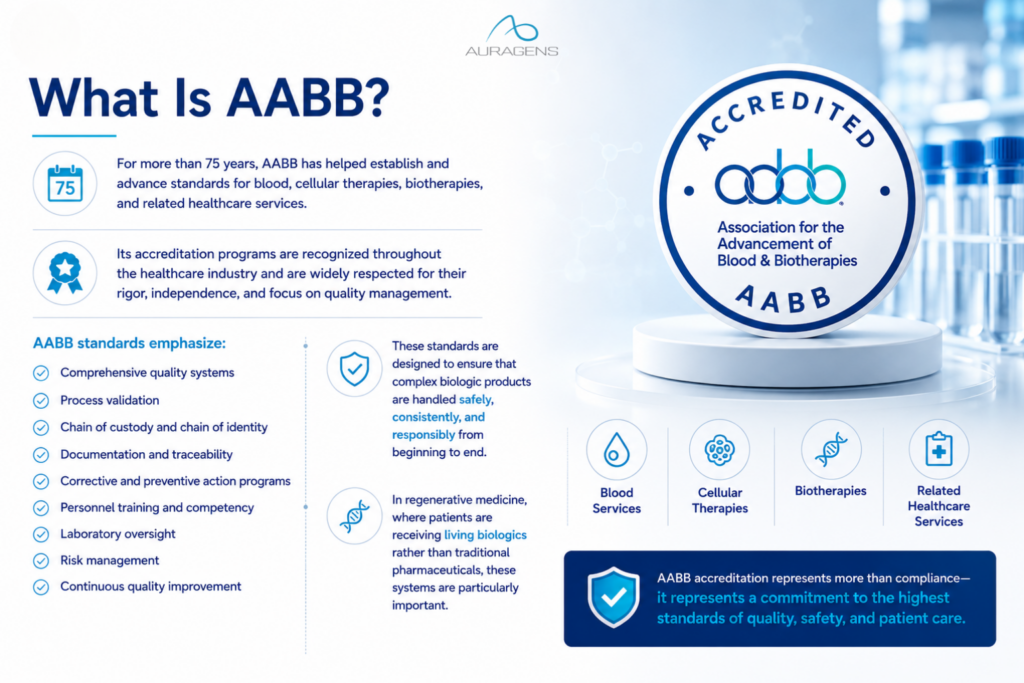
AABB accreditation means an independent assessment team has verified that a facility’s cellular therapy operations meet the published AABB Standards for Cellular Therapy Services. It is a voluntary quality credential covering documentation, process control and quality systems — not a government approval of any specific treatment or product.

The Association for the Advancement of Blood & Biotherapies has set standards for blood and biotherapies since 1947 and has operated its accreditation program since 1957, accrediting facilities in more than 50 countries. Accredited facilities are reassessed on site at the end of each certificate term

Facility: Auragens — Panama
Location: Oceania Business Plaza Tower 1000, Floor 48, Panama City, Panama
Accredited activities: Cell Therapy Activity — Somatic Cells (MSC, Wharton’s Jelly, Cryopreserved; MSC, Wharton’s Jelly, Thawed): Processing, Storage and Distribution
Additional credential: Cellular Starting Material (CSM) Qualification
Effective dates: 1 June 2026 – 31 March 2028


What AABB Evaluates at Auragens

Accreditation is granted for named activities rather than for a company as a whole. Auragens is accredited for the processing, storage and distribution of Wharton’s jelly-derived mesenchymal stem cells. Its separate CSM Qualification covers the donor qualification and collection of cellular starting material.

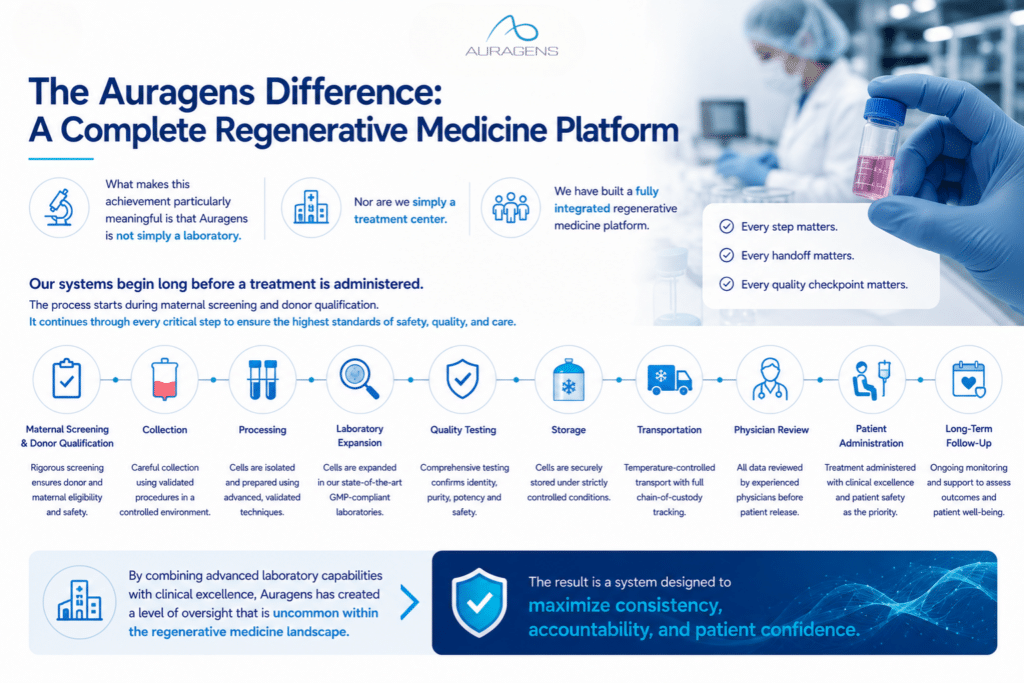
Donor Qualification and Collection

Covered by the CSM Qualification. Cord tissue is donated by healthy, consented mothers delivering full-term babies in accredited hospitals. Screening begins in the second trimester and covers infectious disease, genetics and social history. Donors are never paid.

Processing, Testing and Storage

Cells are cultured and expanded in the on-site Auragens laboratory under ISCT guidelines and Title 21 manufacturing practices. Every batch is assayed for identity, purity, potency, sterility and viability before release.

Traceability and Quality Management

Each batch carries a certificate of analysis and complete chain-of-custody documentation. Quality management extends to training, equipment, environmental monitoring, deviation handling and corrective action — the systems that make a result repeatable.

“The AABB onsite assessment was exceptionally thorough. Their reviewers did not simply look at policies or documentation; they examined how those standards were actually implemented throughout the operation, from donor sourcing and laboratory processes to quality systems, chain of custody, testing, and ultimately the handling of the cellular product through administration. What continues to impress me is the depth of the review and the level of scrutiny applied at every step. Having experienced the process firsthand several times, I can say that achieving AABB accreditation is not simply a credential; it is independent validation that an organization has built the systems, discipline, and culture necessary to operate at an exceptionally high standard in service to our patients.” – Dr. James Utley, Chief Scientific Officer, Auragens

The Auragens Difference

Trust

Accreditation is granted by assessors with no commercial stake in Auragens, and it is not permanent. The current certificates expire on 31 March 2028, at which point the laboratory is reassessed against standards AABB itself revises on a two-year cycle. Trust here has to be renewed, not simply claimed.

Proof

The certificate names the exact activities and cell type assessed, so the credential can be checked rather than taken on faith. Cells are characterized through immunophenotyping and flow cytometry, and every batch is released against documented specifications.

Experience

Treatment runs five days in Panama City, in a purpose-built facility on the 48th floor of Oceania Business Plaza. A Patient Experience Executive coordinates records review, scheduling, travel and follow-up from first contact onward.

Freedom

Auragens is located in Panama, so its treatments are not approved by the U.S. FDA. That distinction is stated plainly here so patients can weigh accredited manufacturing quality against regulatory status and decide with complete information.

Why Quality Processes Matter

Stem cells are living biologics, not shelf-stable drugs. Viability, identity and potency are determined long before a patient arrives — by donor screening, culture conditions, release testing and cold-chain handling. At Auragens, moving from donor screening to a ready biologic can take up to 15 months. Laboratory control is what makes one batch resemble the next. Accreditation verifies those controls exist and are followed; it does not guarantee a clinical outcome.

Questions to Ask a Regenerative Medicine Provider

Accreditation is verifiable. Ask any provider you are considering:

  • Is the laboratory AABB-accredited, and can you see the certificate?
  • Which specific activities and cell types are named on it?
  • What are the certificate’s effective dates?
  • What release testing does each batch undergo?
  • Can you receive a certificate of analysis and chain-of-custody record?
  • Is the treatment FDA-approved, and if not, is that disclosed?

Frequently Asked Questions About AABB Accreditation

Does AABB accreditation mean stem cell treatment is FDA-approved?

No. AABB accreditation is a voluntary quality credential covering the facility and its processes, not approval of a therapy. Auragens operates in Panama and states directly that its treatments are not FDA-approved.

What is the difference between AABB accreditation and CSM qualification?

They are separate credentials. Accreditation covers the activities named on the certificate. The Cellular Starting Material Qualification covers donor qualification and collection of starting material, and AABB states plainly that it does not by itself represent accreditation. Auragens holds both.

What exactly is Auragens accredited for?

Processing, storage and distribution of somatic cells — specifically Wharton’s jelly-derived mesenchymal stem cells, both cryopreserved and thawed. The certificate is effective from 1 June 2026 to 31 March 2028.

Is AABB accreditation required?

No. It is voluntary. AABB standards describe minimum acceptable requirements for cellular therapy facilities and augment, rather than replace, applicable regulations.

How can I verify a facility’s AABB accreditation?

AABB publishes a public directory of accredited cellular therapy facilities on aabb.org. You can also ask any provider directly for its certificate and check the activities and dates listed on it.

Begin Your Medical Review

Submit your medical history for physician review, or speak with a Patient Experience Executive about whether treatment may be appropriate for you.


🔗 Share this page on social media.

Explore Our Leading Science Newsletters